
Showing posts with label Unit 4. Show all posts
Showing posts with label Unit 4. Show all posts
Friday, 2 March 2012

Thursday, 1 March 2012
Review Of The Birds
 Figure One - Poster
The Birds is a 1963 suspense/horror
film directed by Alfred
Hitchcock, loosely based on the 1952 story "The
Birds" by Daphne
du Maurierries of widespread and violent bird
attacks over the course of a few days.
·
Director:
Alfred Hitchcock
·
Screenplay:
Evan Hunter
·
Genre:
Suspense/Horror
·
Duration:
119 Minutes
The film starts off with a young blond Melanie Daniels,
another blond beauty in Hitchcock’s films not that one is complaining, is at a
pet shop when she bumps into Mitch who’s looking to buy love birds for his
sister and Melanie tries and helps him, this shows that Melanie has feelings
toward Mitch, I guess one could say there’s a link between Mitch searching for love
birds and Melanie stalking Mitch to his house.
The film takes its time to get going but of course having two good looking protagonists keeps most the
audience interested up till when things start to get going. The fact that the
birds attack human is never explained is probably the strongest point for the
film others might say its the weakest but personally the film works well
without explaining why, leaving it up to the viewers to decide for themselves.
"The fact that it is never revealed to the
audience why normally peaceful birds suddenly start attacking humans is a
technique that Hitchcock used frequently in his movies. It is called a
MacGuffin (or McGuffin), which Hitchcock defines as "The plot device, of
little intrinsic interest, such as lost or stolen papers, that triggers the
action.” (Murray: 2011)

Figure Two - Famous Scene
Suspense is built up greatly in “The Birds”, especially the scene where
Melanie is outside the school waiting for Mitch’s sister and sits down and the
camera focusing on her and the background where the school climbing frame is
and then back to her smoking looking around while the children signing is
clearly heard and slowly the crows start to land on the climbing frame, the
scene goes on for a few minutes which builds the suspense up and the children
singing going on for awhile, added to the suspense.
“Genuinely disturbing thriller classic from the
master of suspense.” (Newman 2007)
Karma seems to play a big part in the film, Melanie turns up
at Bodega Bay and is attacked by a seagull as she crosses the lake to get to Mitch’s
home on the first day she’s their and after that things only go downhill. Also throughout
the film she is wearing the unlucky colour green which also implies karma not
being on her side.
 Figure Three - Dead Man Scene
The film is an effective horror film for a number of
reasons, first, as one is watching the film, mainly near the end due to the
film slow pace is that this could happen, its very unlikely but it could because
all it is at the end of the day is birds going crazy and attacking. Secondly,
what the film does well is it has great suspense but doesn’t go crazy into gore
aspect, there’s a few gouged out eyes but the film keeps it to the minium which
works better than over indulging in gore.
“The Birds is an effective horror
movie, although in typical Hitchcock style, there is far more scary
anticipation than actual gore.” (Webster 2000)
Illustration –
Bibliography –
Murray, John - http://www.imdb.com/title/tt0056869/faq
Tuesday, 28 February 2012
Friday, 24 February 2012
Trombone Music Research
Pirates Of The Caribbean
Mulan - Ill Make A Man Out Of You
Journey - Dont Stop Believing
Review of Vertigo
 Figure One - Poster
Vertigo is a 1958 psychological thriller film directed by Alfred
Hitchcock, It is the story of a retired police detective suffering from
acrophobia who is hired as a private investigator to follow the wife of an
acquaintance to uncover the mystery of her peculiar behaviour.
·
Release: 1954
·
Director:
Alfred Hitchcock
· Genre: Thriller
Vertigo starts off with a close up shot females face, which show
obsession with the female, then the camera pans to her lips which maybe stand
for lust and then to the eyes for love, which are all the emotions Scottie has
for Madeleine.
After the scene with the females close up shoot, Vertigo hits the ground running, with two
police men chasing a guy on the roof tops, then Scottie doesn’t clear the jump
and his partner ends up falling off after this scene the film’s pace slows down,
what keeps the film interesting is how Scottie deals with his Vertigo.
 Figure Two - Jeff
One of the most interesting things in Vertigo is James
Stewarts character slowly transform from a good retired police officer to this
bad obsessive man who doesn’t care about Judy feelings at all because all he
wants is the woman he fell in love with. Which makes one think, did the
obsession with Madeleine was so much he couldn’t even tell it was her even
though all what had change in her appearance was her colour.
“You watch this guy going slowly over the brink and realize, good
grief, this is Jimmy Stewart.” (Clark 2000)
Going back to obsession, Lust and love are strong themes
throughout the film, Scottie falls in love with Madeleine, and after she jumps
from the church, the love for her dies away but then he bumps into Judy and the
lust begins for her due to her appearance reminding him of Madeleine, then the obsession
kicks in, he starts making her change her appearance, till the audience find
out that she is in fact the woman he fell in love with.
“A haunting meditation on sexual politics, romantic love, and
obsession, Vertigo is one of the greatest surreal movies ever made.” (Levy
2011)
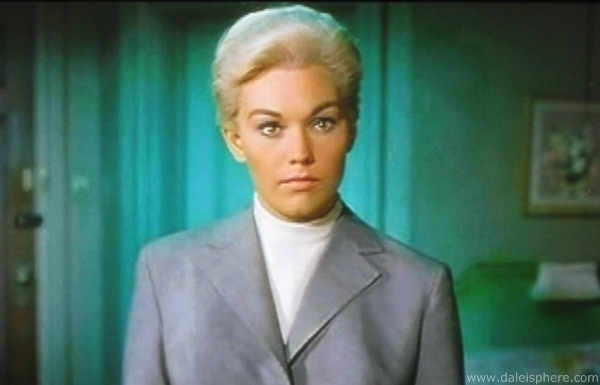
 Figure Three - Wax Model
The look of is generally artificial, weather it was the
performance from Kim Novak or when she was playing as Madeleine, there was a
moment in the film where she paused and she looked a wax figure.
“Justifying Vertigo's poor initial performance, it is a film that
requires distance, as well as the completion of Hitchcock's career. It is a
moment of acknowledgment in the final, retrospective establishment of the
director's frequent theme.” (Taylor 2003)
Illustrations
Bibliography
Review Of Rear Window
 Figure One - Poster
Rear Window is a 1954 American suspense film directed by
Alfred Hitchcock, written by John Michael Hayes and based on Cornell Woolrich's
1942 short story "It Had to Be Murder"
- · Release: 1954
- · Directed by: Alfred Hitchcock
- · Produced by: Alfred Hitchcock
- · Screenplay by: John Michael Hayes
- · Story by: Cornell Woolrich
Telling the story through a camera movement is what Rear
window does best, first off with the opening scene, letting the viewers see
what the film is going to be about early on by showing the rear window of the
protagonist Jeff looking onto the neighbours.
Then the camera moves slowly around a broken camera and
images of dangerous perspective images, from this, the audience find out how
Jeff broke his leg.
“The viewer is made to take the POV of a character who likes to watch
things he's not supposed to see. While suspenseful, the plotline is necessarily
low on action (unlike other Hitchcock masterworks like North By Northwest and The
Birds), but a pet dog is killed offscreen. You might tell kids this was
the direct inspiration for the 2007 teen-bait thriller Disturbia.” (Cassady
2010)
 Figure Two - Mr.Thorwald
The Suspense is built up through number shots, mainly Mr.
Thorwald, leaving his home late at night carrying a large case each time,
cleaning a knife, tying up a large case with rope, this helps build up the
suspense but also let the audience know Jeff simply seeing things, like his
friend suggest he is.
“Rear Window lovingly invests in suspense all through the film, banking it in our memory, so that when the final payoff arrives, the whole film has been the thriller equivalent of foreplay.” (Ebert 2000)
By making the audience perspective as Jeff’s perspective
when he’s watching his neighbour it makes the audience feel helpless along with
Jeff, especially when Lisa is confronted by Mr. Thorwald and Jeff is powerless
to do any think to save her, After the build up of her being caught, the
suspense is returned by Lisa pointing to her finger with the ring on and Mr.
Thorwald seeing her and then looks at Jeff’s direction.
 Figure Three - The Ring
Although
it's an intensely intimate film, there's something special about taking your
seat in the theatre as though you're pulling up right next to L.B. Jefferies
(James Stewart). (Wietzman
2000)
Illustrations
http://en.wikipedia.org/wiki/Rear_Window
http://www.allmoviephoto.com/photo/2005_alfred_hitchcock_collection_005.html
http://simplybek.tumblr.com/post/4031461750/grace-kelly-in-hitchcocks-rear-window-1954
Bibliography
Subscribe to:
Posts (Atom)